Dave Marshall
Copywriter. AI Content Strategist.
If your AI content operation is broken, it's not the tools. It's because of what's sitting between the tools and the output.
Most brands enter AI content creation armed with four assumptions.And they’re either wrong or expensive. Usually both.Yes, the ideation and drafts come fast.But not the asset approvals. Or building the content system.Why? Because the decision-maker is someone who doesn’t know or understand how to implement AI as an actionable part of the company’s eco-system.This leads to unrealistic expectations.So the tool stack grows with each shiny new model or upgrade that’s introduced.Followed by new content ideas, because: "new AI tool"...Which means creating new assets, even as the old ones are cast aside in what I call the “content graveyard”.A dead weight of wasted labor hours burdening the entire system, including budget.This makes consistency hard to master.It’s a series of blows that eventually leads to the fatal one:Thinking that anyone can “do the AI thing” because they’ve copied and pasted a few prompts in GPT or Claude.Slowly but surely, the costs mount. And the discovery that the “AI is cheaper than hiring” way of thinking is completely wrong.That's not a technology problem. That's a judgment gap.And it's costing brands more than they think.And in ways they can’t track.
Case Study:
When AI Decision-Making Meets AI Ignorance
An anonymized account of a brand-level AI content failure.
The Situation
A consumer product brand entered 2026 with real momentum. Everything was in place for launch, the potential for virality real.The product was a solution for something that erodes the quality of life for billions around the world. Its quality and taste were top shelf.The brand identity stood out in its niche, its brand values concrete and well-targeted.All aspects of the marketing were set to “GO”. Copy, design, social media… all in place.A content strategy covering everything from funnels and all things digital to retail plans and collaborations had been built from scratch.This included a full AI content operation designed to produce across multiple formats and platforms simultaneously.On top of all that…?They had secured a partnership with one of the largest YouTube stars in the world to help launch the product. From the start, the brand would have direct access to 400+ million subscribers.On paper, everything was in position.And then it vanished without a trace.
The Work
For months prior, a single practitioner inside the brand had been busy building and operating the entire content infrastructure with the help of AI.This wasn't a tool operator running templates. Or googling ingredients’ benefits. Or researching the target audience and the competitors.No, not how most people use AI.This is what the work included:1 - Developing the brand voice, tone, and content standards from scratch
2 - Building the AI content system: prompts, contexts, workflows, quality filters, platform-specific output
3 - Writing and directing all copy across product pages, sales funnels, landing pages, and social
4 - Evaluating every piece of output against the brand standard before it moved forward
5 - Generating the creatives, without AI which he could have not done before
6 - Managing the creative judgment layer that kept the AI-generated content from being genericThis person spent weeks testing various emerging new AI models and updates for all aspects of this infrastructure.Reading up on what was working and why. Studying what wasn’t working and how to avoid it.Eventually, the practitioner was narrowing down, by daily trial and error, which models to use for what.The system worked because this one person understood both how to direct the AI and evaluate from a business and marketing standpoint what it produced.Those two functions, tool operation and creative judgment, were inseparable in practice, even if nobody had formalized that fact.
What Happened Next
About a quarter into 2026, the practitioner departed the brand. Disagreement was over the role itself and the expectations for that role.Specifically… how AI should be implemented at a strategic level versus as merely a production tool.The brand higher-ups treated AI as if it were software. The practitioner understood it as a system that required ongoing human judgment to function at standard.And NONE of it was as fast as all the AI “gurus” said it was. Not that it wasn’t able to speed up content creation and other types of work…But because many of those said “gurus” are actually very good at marketing and manipulation about what their AI tool could do.That distinction turned out to be the entire ballgame.As a result, few resources were dedicated to building a proper infrastructure that could help the business scale the heights that it had set for goals.The decision-makers distracted by all the shiny new AI tools coming out every day were blind to the obvious:Taking the time to figure out what was needed for each specific part of the business and which tool(s) could get the job done.Everything was done on the fly and without discipline from the higher-ups.Since the departure of that practitioner, the brand simply fell into a black hole.Not a single post on social. Every piece of the sales funnels sits untouched: sales pages, product pages, landing pages, Shopify, etc.Advertised promotions and CTA buttons to purchase lie like dormant volcanoes.Most damning of all…The influencer, despite being fully contracted and paid six figures, has produced exactly ZERO.Not a single thing about the product or brand. No posts. No videos. No mentions.Nothing.A brand that had spent millions in partnerships, marketing, labor hours, and product development had suddenly dropped off the face of the Earth.
The Real Cost
This is not a story about a bad product or a failed strategy.The product was solid, the marketing strategy sound. The copy and creatives were designed to convert.So what happened?A failed assumption, which led to decisions with bad results.See, when decision-makers don’t understand the system being built, or know how to build it themselves, or are always looking for a better way while building the system…Decisions blow up in their faces.When’s the last time you heard of a crew in the middle of construction always changing how they build a real brick-and-mortar skyscraper because the decision-makers behind the architect are directing them to use new tools on a frequent if not daily basis?Never. Because it doesn’t work.It’s a known principle NOT to follow.With AI, there is no such principle. Part of it is its ever-changing evolution and improvement.Thus, gullible decision-makers, especially ones not in the trenches using AI for something more than how to find the cheapest flight ticket, fall for the “shiny pennies” popping up every day.They’re duped into slobbering over the marketing and the “gurus” shouting from the rooftops that AI “will transform/scale your business… and fast.”That’s because there’s a difference between using AI to organize your daily routines or map out your weekly meals…And using it to help run your business.So these decision-makers think that anyone can run the system without the person who built it.It’s a costly mistake on many levels, including hidden ones like the “content graveyard”.Implementing AI into your business for everything from content generation to task automation is not the same as asking AI to help you compare insurance prices.When the person who’s neither done the grunt work nor understands the resulting infrastructure makes decisions about said assets and/or infrastructure…That once-sound infrastructure starts to unravel at the foundation.Decision-makers need to have more than a basic understanding of it. If not, they need to be smart enough to either level up their education…Or grant the architect of it all to have more decision-making powers.It’s one thing to look at a creative or marketing asset and immediately dismiss it before testing it based on a whimsical “like” or “dislike”...But it’s something else entirely to fail to understand the judgment behind how and why the asset was created…Much less the system underlying it.
The Lesson
This is a business infrastructure problem, not a personnel problem.A lack of understanding of how to effectively leverage a technology clearly capable of meeting scaling goals.Brands treating AI content as a tool subscription are one departure away from the same outcome.The fix isn't finding better tools. Or hiring a bigger team. And definitely not enlisting the services of a high-priced “guru”.No. It's recognizing that the human judgment layer in an AI content operation is as critical as any other operational function…And then treating it accordingly.Just ask Ford Motor Company, who learned the lesson the hard way mid-way through 2026.That means:- Understanding the nuances of AI
- Carefully tailoring it to meet your unique needs
- Creating realistic business goals
- Crafting production standards before starting
- Getting consistent, on-brand results
- Not separating the tool operator from the creative judgment
- Building systems that can survive beyond any single personA brand that figures this out first doesn't out-spend the competition. It outthinks them.And thus outperforms them.
----------------------------------------------------------------------------
Want the Full Breakdown?
The case study above is one story. The Execution Gap is the full field report....Packed with all I've learned building, breaking, and fixing AI content operations from the inside.
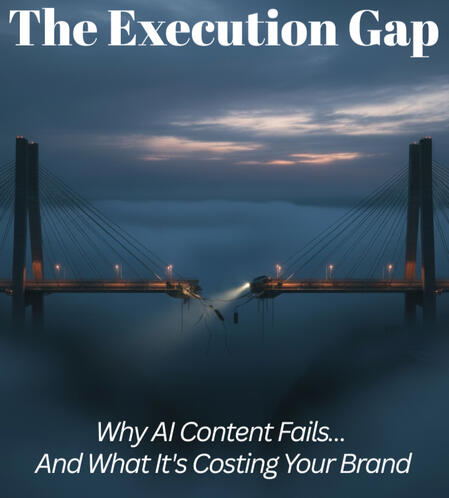
What's inside:
- 4 assumptions quietly bleeding your content budget
- Why "AI is cheaper than hiring" is the wrong math
- The content graveyard, and what it's actually costing you
- The fix — and it's not more tools or a bigger team
========================================================
This case study was written by Dave Marshall and is drawn from direct practitioner experience. Brand and product details have been anonymized. Dave combines 16+ years professional DR copywriting with 4+ years building and operating AI content systems to help businesses grow and be more efficient.
Reach him at [email protected].